

I turned 54 in February, and for most of my camping life I told myself the ground was fine. You get used to it, I said, and I believed it for thirty years. Then came a cold April night on a self-inflating pad that had gone soft in the middle, a night where I woke at 5:40 with my hip against dirt and my back in a knot, and I poured my morning coffee standing at an angle that hurt to look at. That was the last night I spent on a pad.
Last May I bought the Intex Comfort Plush air mattress, the 22-inch queen with the built-in pump, and I have now slept on it fourteen nights across six trips: two campgrounds, my brother-in-law's driveway the night before fishing opener, and three tailgate weekends with the bed in the truck. This is the long-term version of that review. The short version is that I sleep better outside than I do in my own bed half the time, and I have not woken up stiff once.
Choosing the queen was not a hard call. Carol and I have shared a tent for thirty years, and side by side on pads one of us always ended up with an arm pinned under the seam. The queen gives each of us our own lane, and at 22 inches it clears the ground enough that the cold stopped being the thing that woke me. The 4.3 average across more than 27,000 ratings told me I was not the only one finished with pad sleep.
The Quick Verdict
If you camp out of a car or truck and you want mornings that feel like home, the Intex Comfort Plush delivers. Three minutes to inflate, all-night support, and a built-in pump that packs it flat in under ten.
Amazon Check Today's Price →The Bed That Ended My Stiff Camping Mornings
Frank's pick after a full season of trips: the Intex 22-inch Comfort Plush queen with the built-in pump. Three minutes of pump time gets you a bed that sleeps like a box spring, 22 inches off the cold ground.
Amazon Check Today's Price on Amazon →How I've Used It
I did not inflate this mattress once and hand out a rating. I have blown it up on a gravel pad, on sandy ground, under a fly in a thunderstorm, and in the dark at midnight after six hours of driving, and I have kept a note on my phone of inflation time, air loss, and how I felt by 6am after each night. The note on my phone has a row for every night: inflate time, bedtime firmness, morning firmness, and a one-line comment. Reading it back, the pattern is boring in the best way. The mattress has never once surprised me.
Every trip starts the same way. Once the mattress is full I run a hand along each seam, listen at the valve, and sweep the flocked top for anything sharp before the sheets go on. After a cheap air bed failed on me at two in the morning years ago, that check is habit, and it has meant I have never once needed a patch kit at the campsite.
My setup is ordinary car camping. A big tent when the family comes along, a three-person for me and Carol, and a truck bed tent for football weekends. The queen fits each footprint without crowding the walls, and at 22 inches it sits like a bed instead of a floor. You lower yourself onto the edge, swing your legs, and you are in bed. My knees have thanked me every time.
Carol was the original skeptic. After the pad trip she stopped coming on the spring overnights, which is a polite way of saying that June was her first night in a tent in three years. She slept nine hours that first night and has not stayed home since. That single fact is doing more work in this review than anything I can say about beams and valves.
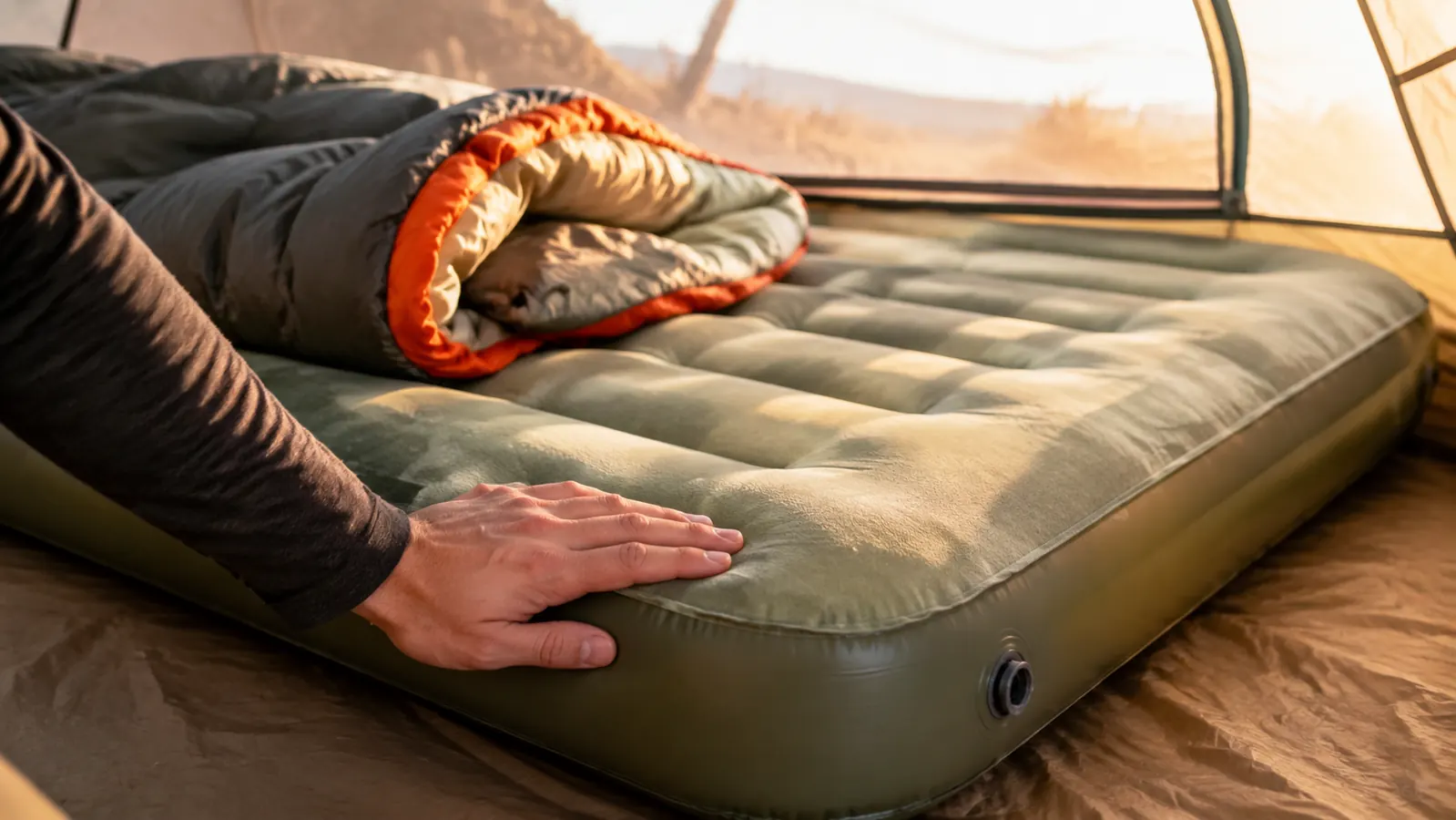
Why 22 Inches Off the Ground Fixed My Mornings
The thing that wrecked my sleep was never the tent floor. It was cold and firmness, in that order. On a pad, my hip found the ground by 3am, the chill soaked up through the bottom, and I rolled like a rotisserie until dawn. The Intex Comfort Plush is built differently. The Dura-Beam construction runs internal air beams instead of one big balloon, so the surface holds its shape under my shoulders and hips rather than bowing out at the edges.
That shape is the whole story. At 22 inches off the floor, the cold has a cushion of air to cross before it reaches me, and that cushion works all night. I slept through a 38-degree night in September with a cold-weather bag and no liner, and my hip never once found the ground. The tight neck I used to blame on camping has not happened in any of the fourteen nights I logged.
Built-In Pump and the Three-Minute Routine
The built-in pump is the feature I would not trade. It draws from a wall outlet when you have hookups, or from the 12-volt port in my truck, which is how I use it on most trips. Three minutes on the inflate setting and the mattress is firm enough to sit on. I run it an extra minute on nights my back feels particular, and that extra pressure is the difference between good and great. The pump is not silent, but it runs for three minutes and then stops, and no neighbor in any site has said a word.
It pulls a second shift as a guest bed at home. When my sister's family visits, the Comfort Plush moves to the spare room, the pump runs from a wall outlet, and two adults sleep through the night without a word. It is not a substitute for a real mattress, but nobody has ever asked for the fold-out couch twice.
Deflating is where the design earns its keep. Open the valve and most of the air walks out in about a minute, then the pump flips to vacuum and pulls it flat enough to roll into the carry bag. On my last trip I timed the whole thing: eleven minutes from a made bed to packed and loaded. For somebody who camps to relax instead of to exercise, that routine matters. The carry bag it comes with is basic, but the straps hold the rolled mattress tight enough that it has never come loose on the bumpy road in to the lake campground.
Cold Ground, Cold Nights
Here is the honest number. By morning the mattress reads a little less firm than it did when I climbed in, and before the second night of any trip I give it a four-second blast from the pump. That is normal for an air mattress and a tiny price to pay. What I have not had is a sinkhole. The internal beams hold their shape well enough that nobody ends up sleeping in a valley by 4am. Firmness is a personal thing, and the built-in pump makes it easy to find yours on the first night and dial it again when the temperature drops, because cold air makes any air mattress read a little softer.
Topping up is part of the night routine now, as much thought as pouring a glass of water. I keep the pump tote by the tent door, and a four-second blast under the valve brings the firmness right back. On cold forecast nights I run the pump before bed instead of after, so I start firm and drift down through the night.
Warmth is where this beats every pad I have owned. Sleeping on top of a column of air instead of on the dirt gives your body heat somewhere better to go, and I feel it most on the nights that dip into the 40s. My bag does the heavy lifting, but the mattress is what keeps my back from turning cold. On the November tailgate, the coldest night of my test, the truck tent frosted on the outside and I slept through till the alarm. On a warm July night the flip side applies: the plush top runs warm, so I sleep on top of a sheet and keep the valve cracked.
What the Plush Top Actually Feels Like
The cover is the detail that separates this from the budget air beds I have owned. The plush surface is soft and quiet, so my sheet stays put and my shoulder does not slide. In a tent at night every little comfort compounds: fabric that does not crinkle, flocking that grips the sheet, a top that is warm to the touch before you climb in. The air bed I slept on in my twenties made a sound like a balloon-pop crowd every time I turned over. This one is silent. And the flocking has held up to fourteen nights with no pilling, which surprises me, because cheap flocked covers pill the first time they touch a zipper.
One honest note about the edges. When I sit fully on the side to tie my boots, that corner dips while the center stays firm. It never dips under me in the night, and for getting in and out twice a night that trade has never cost me a minute of sleep.
The queen layout matters more than people expect. On a twin pad, rolling over means renegotiating your whole position. On the queen, Carol and I each sleep in our own lane, and a midnight trip out of the tent does not wake the other person because the mattress barely transfers motion. I did not buy this for the marriage benefits, but they showed up in the first weekend.

How It Holds Up Trip After Trip
Seven months and fourteen nights is not a decade, but it is more than most people will put on a mattress in five years. I have packed and unpacked it repeatedly, dragged the tote across gravel, and run the pump more than thirty times. The valve seals cleanly every time, the pump has never coughed, and I have not patched a thing. I emphasize that because my last air bed developed a slow leak by its sixth trip, which is the whole reason I am reviewing this one at length.
One maintenance habit I will mention: I store it with the valve open and a little air inside, not vacuum-flat. That follows what Intex's directions suggest, and it keeps the seams from taking a set. Ten minutes when I get home keeps the mattress ready for the Friday when I am running late and everyone else is packed.
Fourteen nights, six trips, one of them at 38 degrees. I have not woken up stiff a single time.
The Tradeoffs Nobody Puts on the Box
Nothing this comfortable is free. The queen rides in a tote of its own and it is the single heaviest item in my camp box. In a car or truck that is a non-issue. For anybody carrying gear on their back it is a nonstarter, and if you backpack, you want a self-inflating pad, full stop.
The pump is also a dependency. I carry a small power station, so I rarely think about it, but if you camp where there is no vehicle, no hookup, and no battery, you are squatting over a foot pump or carrying a separate inflator. The queen also takes up most of a tent floor. That is fine for two people and tight in a tent that sleeps four on paper.
And there is the softness question. Some people want a mattress that is rock hard, and the Comfort Plush rides a little softer than that baseline. The built-in pump lets me add pressure until the seams feel tight, so you can firm it up, but it will always have some give. That is the comfort-first trade, and it is the one I wanted. If your back prefers a board-flat surface, a cabin might suit you better. This mattress is built for comfort, and comfort is the point.
What I Liked
- 22 inches of height, sits and swings like a real bed
- Built-in pump inflates the queen in about three minutes
- Internal air beams hold their shape all night with almost no sag
- Sleeps two comfortably on a standard queen tent footprint
- Vacuum deflate packs it flat in about ten minutes total
Where It Falls Short
- Needs hookup power, a car, or a power station for the pump
- Heavy and bulky, a car-camping-only piece of gear
- Loses a little air overnight, plan a four-second top-up
- Plush top runs warm on hot summer nights
- Sitting on the edge drops the corner more than a framed bed
Who This Is For
If you camp out of a car, an SUV, or a truck, and your idea of roughing it does not include sleeping on the ground, this is your bed. It is for the weekend camper in his 50s who wants to eat and sleep outside the way he does at home. It is for the tailgater who wants to call it a night in the truck bed, and for the spouse who has turned down two trips because the floor hurt her back. It is the piece of gear that changes the whole weekend, the difference between I slept awful and when are we going again.
Who Should Skip It
Backpackers, close this tab and go shop for a pad. If you carry everything on your back for more than a quarter mile, a 22-inch queen air mattress is not for you. Skip it too if you camp somewhere with no vehicle, no hookup, and no power source, because the pump is how it gets firm. And if minimalism is the point of your trip, the inflate, deflate, vacuum routine will read as work. For everyone else I have put this mattress up against a self-inflating pad in a side-by-side comparison, and the full sleeping setup lives in my guide to a good night's sleep at the campsite.
Sleep on It Before You Decide
A full season of nights on the Intex Comfort Plush convinced me. If you camp out of a car, this is the lowest-effort way I know to make the campground feel like home base.
Amazon Check Today's Price on Amazon →