
There is a dent in the edge of my wife's old nonstick pan, and it tells the whole story. It happened at a tailgate three falls ago, when somebody at the grill used a metal spatula a little too enthusiastically and gouged the coating. Nobody meant to do it, which is exactly the point about nonstick. You do not have to abuse one to wear it out. You just have to use it. Scrape it, wash it, let it get too hot once, and the coating gives up a little at a time, until one morning half your cleanup is flaking black flecks into the sink. I have bought four nonstick pans in the last fifteen years, and every one of them died that way, not in a dramatic fire, just a slow and expensive fade.
My Lodge cast iron skillet took the same spatula, the same careless heat, and worse weather over that same stretch, and it did not care. Twelve years in, it still cooks like the day I carried it out of the store. So when that tailgate pan finally gave up, the camp box and the kitchen got into a quiet argument about which pan earned the spot back. My wife wanted another nonstick. I wanted to find out whether the Lodge could honestly do everything she kept a second pan for. So I did the only thing that settles a gear argument in my house: I cooked the same four meals in both pans for a month, half on the stove and half over the fire. Steaks, eggs, burgers, and skillet cornbread, the whole comfort food lineup, taking notes on heat, sticking, cleanup, and how each pan held up. I scored every meal on how it released, how long cleanup took, and whether I would do it again on a wet campsite morning or in a crowded parking lot. The month split cleanly in two, and that split is the whole point of this article.
| Lodge Cast Iron Skillet | Nonstick Skillet | |
|---|---|---|
| Upfront price | Similar to a mid-range nonstick, and you buy it once | Often a few dollars less at the register |
| Heat tolerance | Happy on campfire coals, a grate, or in a 500-degree oven | Comfortable to about 400 to 450 degrees before the coating objects |
| Eggs and sticking | Releases an egg when seasoned and used right, takes butter and heat control | Eggs slide around with almost no oil, right out of the box |
| Cleanup | Hot water, a scrub, thorough drying, and a film of oil. A ritual, not a rinse | A soapy sponge and twenty seconds, then it is done |
| Weight | Around five and a half pounds, you feel it in the camp box and the flip | A couple of pounds, easy one-handed and easy to pack |
| Durability | Twelve years of metal spatulas, coals, ovens, and moves, and it cooks like day one | The coating chips and flakes under normal use, and once it does, the pan is finished |
| Sear and browning | Gets properly hot and holds it, a real crust on a burger without a second thought | Browns fine on medium, but you hold back off the heat before a true sear |
| Care required | Needs drying and oiling, the occasional re-season, and it rewards all of it | No care at all, which is exactly why it wears out |
| Best for | Campers, tailgaters, and anyone who wants one do-everything pan that never quits | Kitchen cooks doing eggs, fish, and delicate weeknight meals |
Where Lodge Cast Iron Wins
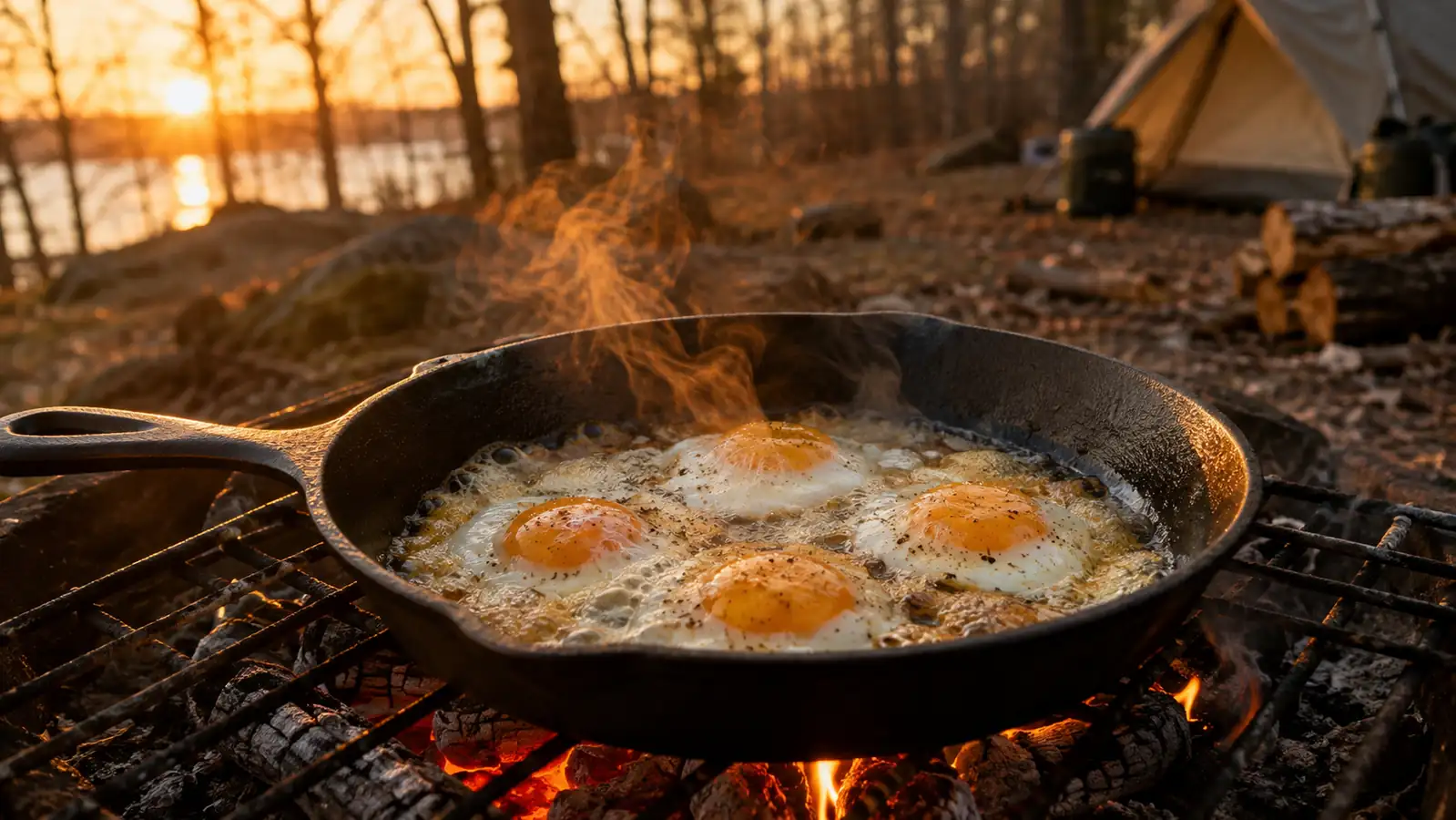
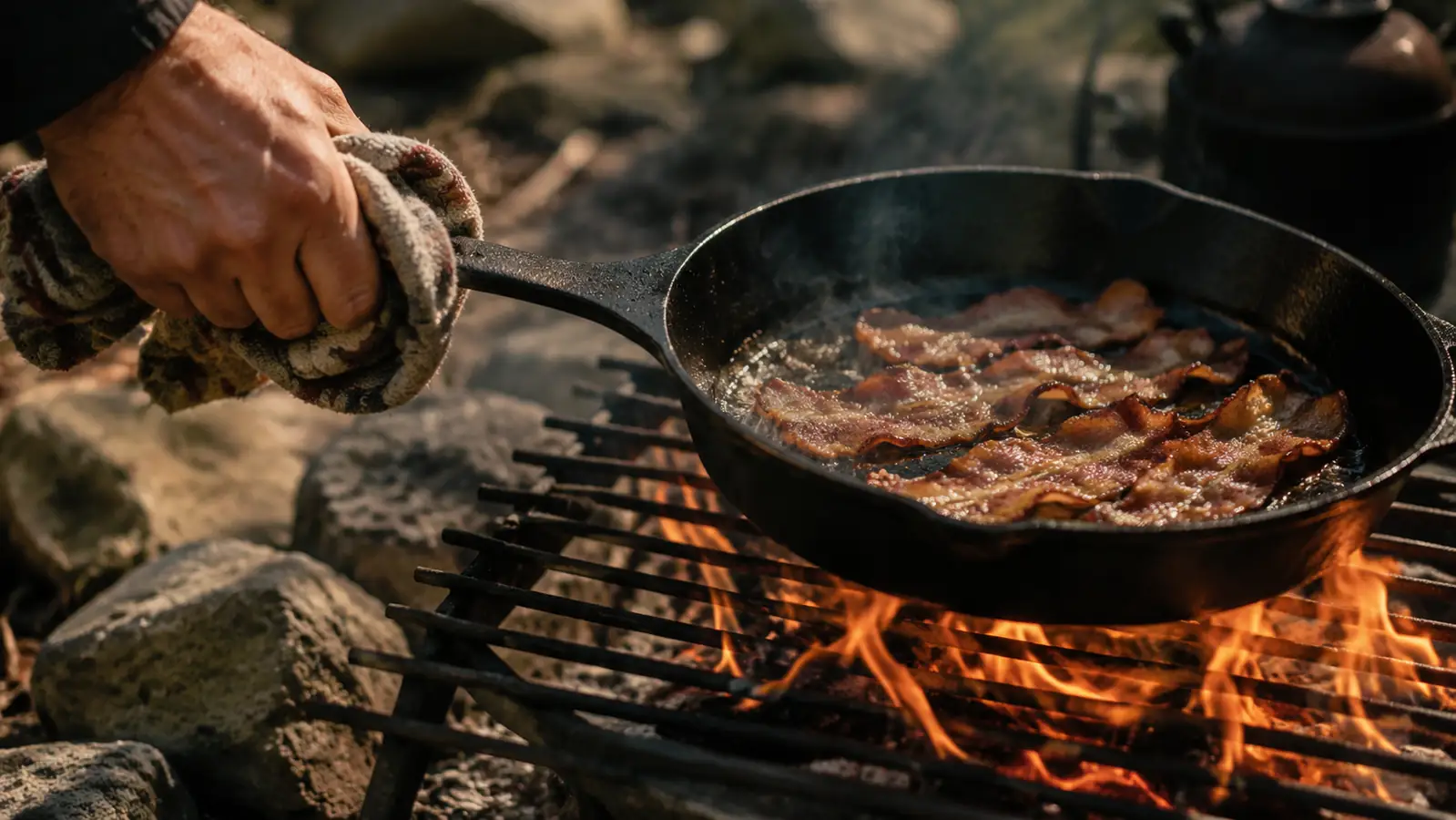
For me, the Lodge wins where camp cooking actually turns: heat and staying power. A nonstick pan is a fine stove pan until you need a sear. You cannot get a proper crust on a burger without creeping past the temperature the coating likes, and when something scorches on one, you get a rough cleanup and a more fragile pan. The Lodge gets properly hot, sits on a propane burner or right down on the coals, and holds that heat through a whole batch of bacon without dropping a degree. That matters more at a campsite than anywhere else, because out there you do not have a range hood, a preheated oven, or a second chance. You have a grate and a fire, and the Lodge was built for exactly that.
The staying power is what sold me over a decade ago, and nothing since has changed my mind. I have used metal spatulas on this pan, set it directly on campfire coals, run it through three moves and more weekends than I can count, and once left it out in the weather by accident. Twelve years in, it looks like somebody's grandmother's pan, and I mean that as a compliment. Cast iron does not wear out, it accumulates. Every burger, every skillet of cornbread, every camp breakfast oils the surface a little more, so the pan gets better with age while every aluminum pan in the cupboard gets dinged and tired. Nonstick pans expire on a schedule. This one has no schedule.
It also earns one space in the kitchen, the camp box, and the truck bed without a second thought. I cook with it at home on a Tuesday and over a fire on a Saturday, and it does not care where it is. Across a full month of side-by-side meals, I never once packed the Lodge for a trip and wished I had brought the other pan along instead.
One honest note before anyone writes me off as a cast iron fanatic: there is a short seasoning awkwardness with the Lodge, and pretending otherwise would be dishonest. Out of the box it is pre-seasoned, which gets you most of the way there, but the surface still grabs more than a nonstick in the first few weeks. I regularly get asked how to handle that. I skipped the drama, cooked bacon in it for the first month, kept it oiled, and dried it over the burner every single time, and by the end of that month the eggs came off clean. It is not a project. It is just a pan that needs a little of your attention while it earns its release.
Where Nonstick Wins
I am not going to pretend the other side has nothing going for it. For straight weeknight cooking, a nonstick pan is genuinely more pleasant a lot of the time. Eggs slide around with a whisper of butter. A splash of water after dinner, twenty seconds with a sponge, and the thing is clean before the coffee is done. If your cooking life happens on a stove at home, especially omelets, fish fillets, or anything delicate, the nonstick is the low stress choice, and I would not argue with anyone who picks one for that job. My wife is right about that part, and I told her so.
The other thing working for the nonstick is weight. A ten inch nonstick is featherlight, easy to move one-handed and easy to tuck into a cupboard or a camper bin. The Lodge weighs more than five pounds, and you feel it when you pack the truck and again when you flip a full pan of hash. That is a real tradeoff, not a small one, and it is the first thing everybody says when they pick up the Lodge. I haul it because it cooks the way it does, but I am not going to tell you the weight is nothing.
There is also the learning curve, or the lack of one. The nonstick works the way you expect a pan to work from day one: no seasoning, no heat management, nothing to learn. The Lodge asks you to dry it completely, wipe on a film of oil, and learn how the heat moves across it. For a cook who just wants dinner on the table, that is friction, and I will not pretend it is not. It is a small amount of care, but it is care, and that matters to some people more than others.
There is one more credit to hand the nonstick, and it matters more than most gear reviews let on: weight matters to the person actually doing the cooking. My mother in law has a hard time lifting heavy pans, and for her a featherlight nonstick is the thoughtful choice, not the lazy one. I would not hand her a five pound skillet and call it consideration. So when you make this call for your household, do not just think about the frying arm, think about whose mornings are spent at the stove.
If you cook outside, this is the pan to build your camp box around
The nonstick is easier to clean and better at eggs. The Lodge wins everywhere food meets fire and time: camp breakfasts, tailgate burgers, and the kind of years that turn a normal purchase into an heirloom. For the cooking most of us actually do, it is the pan I reach for every single trip.
Amazon Check Today's Price on Amazon →The Coating Question, Addressed Honestly
One more difference deserves its own space, because it has become a real question in a lot of households. A nonstick pan works because of a coating, and for years those coatings were tied to a class of chemicals that scientists kept debating. This Lodge skillet is PFAS-free for the simplest of reasons: it does not have a coating at all. The cooking surface is bare iron and oil. That takes an entire category of worry off the table for my family, and it is one more reason this pan outlives everything else in the drawer.
I am not going to tell you every nonstick pan on the shelf is dangerous, because that kind of sweeping claim helps nobody and most brands changed their formulas years ago. But I will say this plainly. Once you have cooked on plain iron, a synthetic layer between the pan and your food starts to feel like something you would rather not need. When a coating starts to scratch, you should not have to wonder what is flaking into the eggs. With bare iron, there is nothing to wonder about.
How I Keep the Lodge Happy in a Camp Box
The question I get most often about this pan is how it survives the back of a truck, and the answer is less fussy than people expect. I wrap it in a folded towel or stack it with a paper plate between the pan and the cooler, because the real enemy in a camp box is not rust, it is a heavy cooler sliding across the cooking surface. Last summer one slid on a gravel road, dragged a line across the seasoning, and a single wipe of oil had the surface looking good as new.
For rust, the rule is boring and easy. Dry it completely after every wash and keep a thin film of oil on it. I do that on cold mornings with a paper towel while the coffee heats, and across a full season of outdoor cooking I have not seen a single orange spot. Even when you drop the ball, and I have, a scouring pad and twenty minutes brings a rusty skillet right back to fine. Try that with a coating that has worn through.
Who Should Buy Which
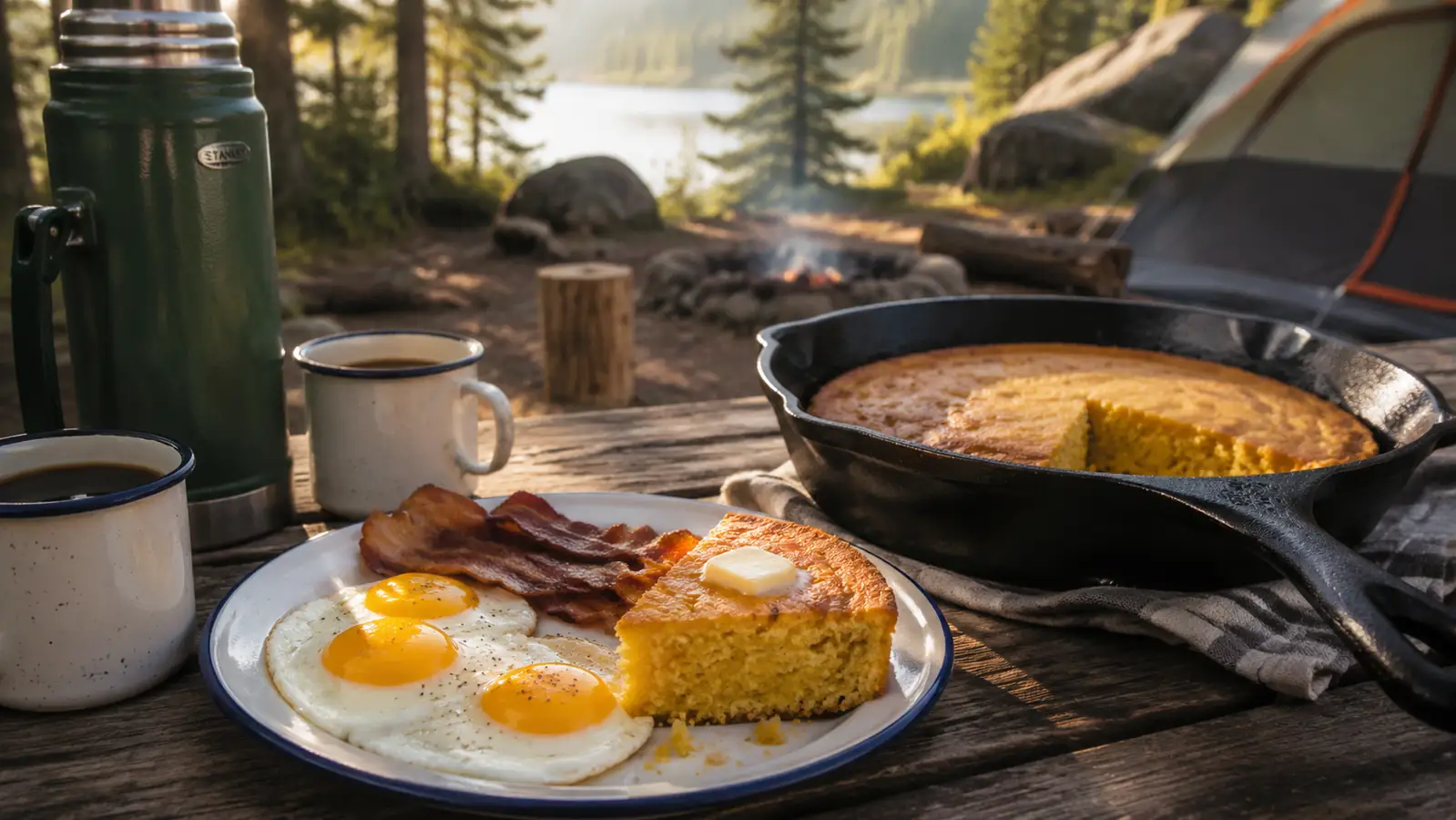
Buy the Lodge if you cook at a campsite, at a tailgate, or over any fire that is not your stove. Buy it if you want one pan that handles eggs, burgers, steaks, skillet cornbread, and a full campfire breakfast without thinking twice. Buy it if you are tired of replacing pans, because short of lending it out for a generation, this is the last skillet you will need to buy. If you are the kind of camper this site is written for, the one who wants breakfast at the campsite to feel as good as breakfast at the kitchen table, the Lodge is the pan that gets you there.
Buy the nonstick if you cook almost entirely indoors on a stove, for small delicate meals, and you have no interest in a pan that asks for care. To be clear, you do not have to pick just one. The setup that makes the most sense to me is one of each, and I bet it makes sense to most of you too. I keep a nonstick in the kitchen for the nights my wife wants a quick Tuesday scramble, and the Lodge goes into the camp box every single trip, packed first so nothing heavy sits on top of it. If I could only keep one though, and I camp every chance I get, the answer is the Lodge, and it is not a close call.
The real takeaway from that month of side-by-side cooking is simple: the nonstick won the weekdays and the Lodge won the weekends, and the weekend is the part I actually care about. That is the honest accounting, and it is why one of these pans has a permanent seat at our fire.
If you are still on the fence after all of that, run the test I ran: cook your favorite breakfast on a Saturday in whatever pan you already own, then picture doing that same meal over a fire, with wet hands, cold mornings, and no sink in sight. The Lodge shrugs off everything a campsite throws at cookware. Thin coatings and aluminum bottoms do not. That one picture is the whole argument for the Lodge in a single sentence, and it is the reason this pan rides to every trip.
The Reviews Back It Up
If that month of testing sounds like one man's opinion and you want a bigger sample size, the numbers behind this pan are hard to argue with. When I last looked, the Lodge 10.25-inch carried more than 130,000 customer reviews and held a 4.6-star average. I have bought a lot of cookware over the years, and I have never seen a pan keep a rating like that at that kind of volume. Nonstick pans wear out in every kitchen at about the same rate, and their averages drift down for it. This one just keeps cooking.
One pan for the fire, the stove, and the next two decades
The Lodge pre-seasoned skillet has been my go-to for twelve years, and it is the pan I recommend to anyone who cooks outside. If you camp, tailgate, or just like breakfast that tastes like it took effort, check today's price and give it one trip. It will be the last skillet you buy for a long while.
Amazon Check Today's Price on Amazon →