

It starts the same way on every trip, and you know it before you open your eyes. The neck is stiff, the kind of morning where you turn your whole upper body instead of your head, where you stand at the picnic table holding your coffee in one hand and rubbing the back of your neck with the other. That was me for about two years of weekend camping, and I blamed everything except the actual cause. It was the ground. It was my age. It was the camp mattress pads. None of it was true, and Carol is the one who finally said it out loud on our third bad trip in a row: 'Frank, you're sleeping on a flannel shirt stuffed into a stuff sack, and you're surprised your neck is sore?'
The fix turned out to be embarrassingly simple, and it had nothing to do with a cot, a chiropractor, or a different campground. It was a compressible memory foam pillow from a company called Ivellow, plus two or three adjustments to how I set up the bed inside the tent. Six weekend trips later I've woken up stiff exactly once, and that was the night I left the pillow in the car. What follows is the exact setup I use now, step by step, because the sore neck problem is almost never the campsite. It's the angle your head spends eight hours hanging in.
The whole thing comes down to one idea: your neck has to bridge whatever gap sits between your shoulder and the pad under you. Lie on your side with a flat, shallow pillow and your skull drops, bending your neck down toward the ground all night. Lie on your back with a tall lumpy pillow and your chin points at the tent ceiling, and the front of your neck does the work. Either way you spend eight hours holding a position your spine would never choose on its own, and you wake up paying for it. Every step below is aimed at closing that gap and keeping it closed.
The One Change That Fixed My Camp Mornings
If you only swap one thing in your camp bedding, swap what's under your head. The Ivellow shredded memory foam pillow compresses into a carry bag about the size of a water bottle and fluffs back out to real pillow height. Check today's price on Amazon and decide for yourself.
Amazon Check Today's Price on Amazon →Step 1: Quit the Shirt-Stuffed-Under-Neck Approach
The rolled-up flannel, the balled-up jacket, the second hoodie shoved into its own sleeve. I used all of them across years of car camping, and they are the number one cause of a camp neck. A bundle of cloth doesn't hold your head level. It supports one point of your skull and leaves everything else to your neck muscles, which quietly work all night to keep your head from rolling off the lump. You might as well hold a book up with your chin for eight straight hours.
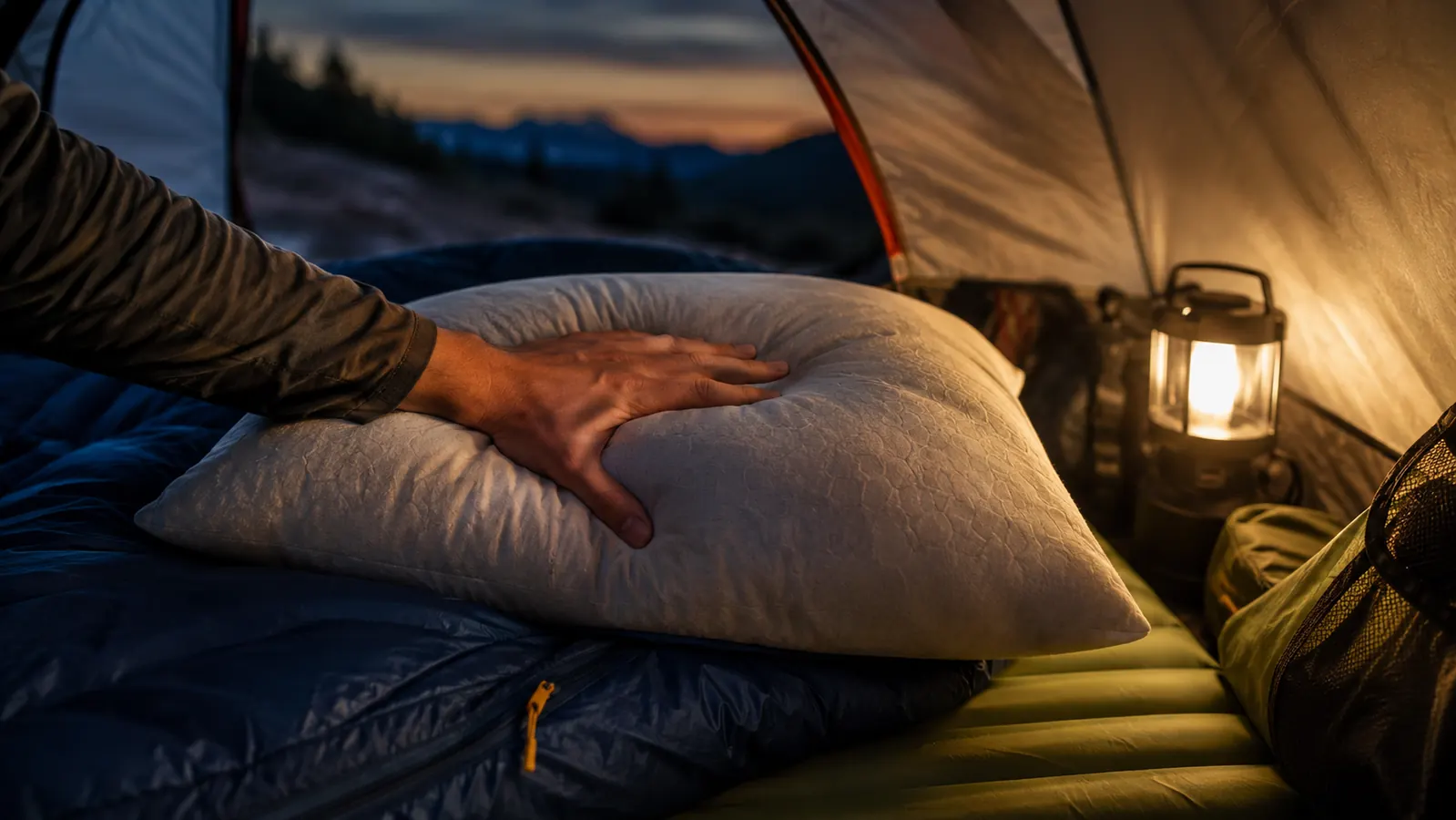
This is why a compressible memory foam pillow earns its spot in the tote before most other bedding upgrades. The Ivellow packs down into a carry bag roughly the size of a water bottle, so it stops being the reason your gear tote won't close. But the packing trick isn't the point. The point is what happens when you unroll it: over a minute or two the shredded foam expands back to about the loft of the pillow you sleep on at home. It never needs inflating, it never hisses at midnight, and it does not slide off the pad the way an air pillow does on your first toss and turn.
One habit worth stealing from me: fluff it when you set up camp, not when you're crawling into the sleeping bag at midnight. The shredded foam expands much faster when you take the compression strap off early in the evening. Give it a two-minute knead with both hands, set it on your pad, and by the time the fire dies down it's a real pillow waiting for you.
Step 2: Set the Height for How You Actually Sleep, Not How You Wish You Did
Pillow height is not a one-size answer, and this is where most campers, including me for a long time, get it wrong. Side sleepers need the most loft, because the gap between the ear and the outside shoulder is the widest. Back sleepers want a flatter pillow so the head stays in line with the spine. Stomach sleepers want almost nothing under the head at all, which should come with its own warning label.
I am a side sleeper, so my Ivellow setup goes like this. I let it fully fluff, then I press the center down a little to form a shallow cradle that sits right under my skull. Because the fill is shredded foam, it moves where I push it, which means I can tune the height in about ten seconds. If a night feels off, I shift a handful of foam from the middle out to the edge, and it behaves like a different pillow. That adjustability is the entire reason I stopped carrying inflatables.
I compared memory foam against inflatable travel pillows in a separate article, and what I kept finding at 2 AM matched the conclusion: an inflatable is a fixed height you can only add air to, and the air shifts as you shift. The shredded foam holds its shape, adjusts to you, and stays put. For a side sleeper that is the difference between a pillow and a balloon with a problem.
Step 3: Line Up the Whole Spine, Not Just the Neck
A good pillow does most of the work, but it cannot fix a body that is twisted from the hips down. If you sleep on your side, put something between your knees. A rolled towel, a folded fleece, even the empty pillowcase stuffed with a spare flannel will do. That little block keeps your top hip from dropping forward and twisting your lower back, which is the quieter half of the stiff-morning feeling.
If you sleep on your back, slide a small roll under your knees. It takes the tug off your lower back and lets your neck settle into the pillow instead of bracing against the rest of your spine. The whole goal is one line: ear, shoulder, and hip in a straight row when you're on your side, and a flat, supported back when you're on your back. When the spine is neutral, the neck has nothing left to fight, and that is when the pillow can finally do its job.
This is also the fix that shows up at home. Once I started using a knee block in the bed at home, my mornings got easier there too, which tells you the principle isn't a camping thing, it's an anatomy thing. The campsite just makes the mistake louder, because the pad is firmer and the pillow is usually worse.

Step 4: Keep the Neck Warm, Because Cold Muscles Wake Up Cranky
Cold air is the quiet saboteur of a good camp night. If your sleeping bag gaps open at the shoulders, or your head is pressed flat against the tent wall, that whole side of your neck stays chilled for hours. And cold muscles are stubborn muscles. The stiff neck you wake up with at six in the morning is very often a cold neck from two in the morning; it just waits until dawn to announce itself.
Two cheap fixes fixed it for me. First, tuck the top of the sleeping bag up around your shoulders like a hood so the warm air stays in. Second, keep your face a few inches off the tent wall so there's an air pocket instead of a damp cold patch against your cheek and neck. On genuinely cold nights I sleep in a thin fleece neck gaiter. It looks a little odd at breakfast, but I'd rather look odd and loose than normal and stiff.
And this matters more than it sounds. A neck that has been cold all night is also a neck that has been tense all night, because muscles contract to make heat. So the morning stretch is harder, the frozen feeling lasts longer, and the first hour of the day is shot before you pour the coffee. Keeping that air pocket is a thirty-second fix with an all-night payoff.
Step 5: Start Slow in the Morning and Give the Setup a Full Weekend
The first five minutes after you wake up decide how the whole day feels, and I learned this the hard way. I used to pop up, swing my head around to take in the campsite, and spend the next hour regretting it. Now I wake up in stages. I sit up slowly, I do a slow chin-to-chest press, then I roll each ear toward its own shoulder and hold for a few breaths. By the time the coffee is poured, whatever stiffness is there has mostly melted.
My second rule is to give any new setup a full weekend before judging it. The first night with the Ivellow I half expected to be reaching for a sweatshirt at two in the morning, old habit. I wasn't. By Sunday morning I had slept loose three nights in a row, and on the drive home I stopped mentally planning for a stiff Monday.
And that is the real win, because a loose morning changes the whole trip. Breakfast tastes better when you're not wincing, the hike feels better, and cooking bacon over the fire becomes a joy instead of a chore done in spite of your neck. It sounds like a small thing until you add up how many trips I nearly cut short, or at least complained my way through, because of one stiff neck.
What Else Helps
A short list of smaller things that pull their weight. Drink water before bed. I'll take the lecture, too, because I noticed my stiffest mornings always followed the nights I skipped the water bottle and finished the last beer at the fire. Dehydrated muscles stiffen faster and recover slower. One glass of water at lights out, and I sleep cooler and wake up looser.
Wash the pillow cover once a season. The Ivellow cover unzips and goes in the machine, and a season of campsites and tailgates means it has earned a wash. Hang it in the sun to dry and it keeps its shape. It's the same pillow that has been on every trip in my long-term review, and that review covers the durability and packing details if you want the full picture.
Six weekend trips later I've woken up stiff exactly once, and that was the night I left the pillow in the car.
Start Tonight: Swap the Shirt for a Real Camp Pillow
You don't need a new mattress or a cot to fix a camp neck; you need a real pillow under your head. The Ivellow compresses into a carry bag about the size of a water bottle, fluffs back out to home-pillow height, and costs less than what most campgrounds charge for a site. It is the single change that fixed my camping mornings. See today's price on Amazon and decide for yourself.
Amazon See Today's Price on Amazon →